When one spouse is leaning toward divorce and the other wants to save the marriage, traditional couples therapy is often not the right place to start.
Discernment counseling helps couples gain clarity about whether to pursue divorce, remain as they are, or commit to a serious effort to repair the relationship.
Not Sure Whether to Save Your Marriage or Divorce?
You may have reached a point where the future of your marriage feels uncertain.
Perhaps one spouse is considering separation or divorce while the other wants to save the relationship.
Maybe you’ve spent years having the same painful conversations, feeling stuck between hope and discouragement.
For some couples, the relationship has become emotionally exhausting. Others have already tried couples therapy and left feeling disappointed, unchanged, or even more confused about what to do next.

Many are terrified of making the wrong decision – either ending a marriage that could have been repaired or staying in a relationship that is no longer healthy.
Discernment counseling was created specifically for couples facing this kind of crossroads.
It is designed to help you slow down, gain clarity, and make a thoughtful decision about the future of your relationship.
Discernment counseling may be appropriate if:
- One spouse is leaning toward divorce while the other wants to save the marriage
- You have experienced years of recurring conflict or emotional disconnection
- One or both partners feel emotionally exhausted and unsure how much longer they can continue
- Previous couples therapy did not provide the clarity or progress you hoped for
- You feel stuck between staying and leaving
- You are afraid of making a decision you may later regret
Discernment counseling is designed specifically for couples who are uncertain whether to continue working on the marriage or move toward divorce.
What Is Discernment Counseling?
Discernment counseling is a short-term, structured process designed for couples who are unsure whether to stay together or move toward divorce.
It is different from traditional couples therapy because the goal is not to fix the relationship right away, but to help each partner gain clarity about what they want and what is realistically possible.
This approach was developed by couples therapist and researcher Dr. Bill Doherty for situations where one partner is leaning out of the relationship and the other is still hoping to save it.

The focus is on slowing down intense conflict, understanding each person’s perspective, and making a thoughtful decision about the next step – whether that is separation, staying together as-is, or committing to couples therapy.
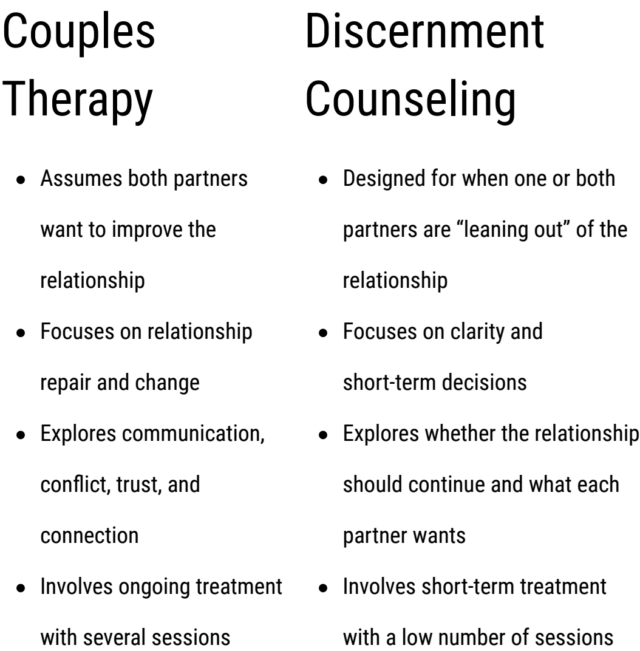
How Is Discernment Counseling Different From Couples Therapy?
Who Is Discernment Counseling For?
Discernment counseling is for couples who feel stuck at a major crossroads in their relationship and need clarity before making a permanent decision.
It is especially helpful when conversations about the future keep circling without resolution, or when both partners are experiencing the same situation very differently.
It can also be a good fit when there is enough emotional investment to make the decision feel difficult but not enough clarity to know what the next step should be.

Common Issues for Why Couples Seek Discernment Counseling:
- Ongoing uncertainty about whether to stay together or separate
- Difficulty reaching agreement about the future of the relationship
- Feeling emotionally disconnected despite years together
- One or both partners feeling overwhelmed by repeated conflict cycles
- Concerns about long-term compatibility or unmet needs
- Situations where trust has been significantly impacted
- Feeling “stuck” despite previous efforts to improve the relationship
What Happens During Discernment Counseling?
Discernment counseling is a brief, structured process designed to help couples slow down, reduce reactivity, and make a clear decision about the direction of their relationship.
The process typically includes 1–6 sessions, depending on the couple’s situation and how quickly clarity emerges.
Session Structure
Most couples move through a consistent format:
Initial joint session (both partners together) for 90-120 min:
- Gather brief family history
- Clarify what brought you to discernment counseling
- Identify each partner’s current position (stay, leave, or unsure)
- Establish the goals of the process (clarity, not pressure or persuasion)
Individual sessions (each partner separately) for 50-90 min:
- Explore each person’s perspective on the relationship
- Understand concerns, hopes, and hesitations
- Identify patterns contributing to conflict or distance
- 1-2 sessions with each partner (total of 2-4 individual sessions)
Final joint session for 90-120min (OR ongoing alternating sessions, if needed):
- Reflect on what has been learned
- Clarify what each option would realistically look like including impact on children, if applicable
- Reduce emotional reactivity and increase thoughtful decision-making
Frequency & Duration
- Most couples complete the process within 1–6 sessions
- Sessions are typically spaced weekly or as needed for clarity
- The process ends once a clear direction has been reached
The goal is not to prolong therapy, but to help you make a thoughtful, informed decision you can move forward with confidently.

The Three Possible Paths AFTER Discernment Counseling
At the end of discernment counseling, couples typically arrive at one of three clear decisions about how to move forward.
1) Continue the relationship as it currently is
Some couples choose to maintain the status quo, recognizing that while challenges remain, they are not ready to make a major change.
2) Separate or move toward divorce
Some couples decide that the healthiest next step is to end the relationship in a thoughtful and intentional way.
3) Commit to a defined period of couples therapy
Some couples decide to re-engage in couples therapy with a clear focus on repair and change. This is typically a structured commitment (often several months) designed to actively work on improving the relationship rather than remain in uncertainty.
During this phase, the focus is on meaningful therapeutic work aimed at addressing core patterns in the relationship.
The intention of this path is to give the relationship a genuine opportunity for change before revisiting longer-term decisions.
What If My Spouse Refuses Discernment Counseling?
Discernment counseling requires both partners to participate in the process. If your spouse is unwilling to attend, discernment counseling would not be appropriate at this time.
However, you may still benefit from individual relationship therapy.
Individual sessions can help you better understand your relationship patterns, clarify your goals, improve communication, and make thoughtful decisions about the future of your relationship, even if your partner chooses not to participate.
See below for more info.
Discernment Counseling Throughout Virginia
I provide discernment counseling for couples throughout Virginia through secure virtual sessions.
This allows couples to access specialized support regardless of where they live, including Northern Virginia, Richmond, Virginia Beach, Chesapeake, Norfolk, Arlington, Alexandria, Fairfax, and surrounding communities.
For couples who prefer to meet in person, limited appointments are available at my Vienna location.

Your questions, answeredFAQs About Discernment Counseling
Please visit Appointment Times & Session Fees for the most up-to-date therapy fees.
No. Discernment counseling is not traditional couples therapy.
It is a short-term process designed to help couples gain clarity about whether to continue the relationship or move toward separation.
Couples therapy focuses on improving the relationship itself, while discernment counseling focuses on decision-making first.
Most couples complete the process in 1-6 sessions. The exact number depends on how quickly clarity develops and how much dialogue is needed to understand each partner’s perspective.
Discernment counseling requires both partners to participate in the process.
If your partner is unwilling to attend, discernment counseling would not be appropriate at this time.
However, you may still benefit from Individual Relationship Therapy.
Individual sessions can help you better understand your relationship patterns, clarify your goals, improve communication, and make thoughtful decisions about the future of your relationship, even if your partner chooses not to participate.
See below for more info.
No. The goal is not to produce a specific outcome, but to help both partners make a thoughtful, informed decision about the future of the relationship – whatever that decision may be.
Yes. Many couples seek discernment counseling after previous therapy did not provide clarity or meaningful progress.
It can be especially helpful when couples feel stuck between continuing attempts to repair the relationship or moving toward separation.
Yes. Sessions are available virtually for couples throughout Virginia.
For those in Northern VA, you also have the option of in-person sessions at my Vienna location.
Start Here
Appointment Hours
10:00am - 8:00pm
Both virtual & office sessions available
Telephone
Address
243 Church St NW
Vienna, VA 22180