If you’ve ever thought, “Why do we keep having the same argument?” you’re not alone.
Many couples come to therapy feeling stuck in the same patterns:
- One partner shuts down
- The other pushes for resolution
- Small issues turn into big disconnections
These communication problems in marriage aren’t random.
While many couples understand that personality differences and attachment styles contribute to how they fight, a lesser known influence is the “ACE score.”
Understanding your own ACE score can deepen your understanding of your own role in your relationship conflict.
What is an ACE score?
ACE stands for “Adverse Childhood Experiences.”
It’s a simple framework used to understand how early experiences – like abuse, neglect, or growing up in a high-stress home – impact your emotional and relational patterns as an adult.

It’s a key piece in understanding trauma and relationships.
Scores range from 0 to 10, with higher scores indicating a higher number of adverse experiences that happened before your 18th birthday. The higher your score, the more dysfunction and abuse you were exposed to as a child.
If you’re curious about your own score you can take the quiz from the American Society for the Positive Care of Children.
ACE scores don’t just impact your relationship – they can shape your health, your emotional resilience, and the ways you cope with stress. For example, higher ACE scores have been linked to:
- Sleep problems
- Chronic illness
- Substance abuse
- Emotional problems later in life
If you’re reading this, please understand that your ACE score isn’t about blaming your past or your parents. It’s about understanding why certain moments in your relationship feel so intense and why high-conflict couples often get stuck in repeating cycles.
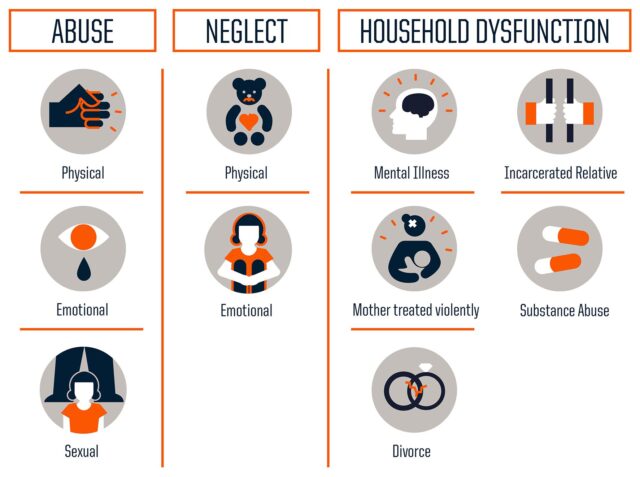
Credit: Robert Wood Johnson Foundation
Here are three things to consider about the connection between your ACE score and your relationship.
1. Your stress response is affecting your relationship
If you grew up in an unpredictable or stressful environment, your nervous system learned to stay on high alert.
In relationships, that can show up as:
- Reacting strongly during disagreements
- Feeling easily overwhelmed in conflict
- Shutting down or emotionally checking out
This is one of the most common drivers behind relationship conflict and communication issues. What looks like an overreaction is often your nervous system trying to protect you.

2. Your attachment patterns shape how you communicate
Your early experiences don’t just affect how you handle stress – they also shape how you connect.
You might:
- Fear abandonment or rejection
- Need constant reassurance
- Avoid vulnerability or emotional closeness
- Struggle with basic trust
- Fall into people-pleasing patterns
These negative patterns are at the core of many couple conflicts.
What gets labeled as “too needy” or “emotionally distant” is often a learned way of staying safe in relationships, rooted in your childhood.
3. You can change these patterns, with the right support
Your ACE score may help explain your patterns but it doesn’t have to define your relationship.
With the right couples therapy approach, you can:
- Understand your triggers instead of reacting automatically
- Break out of repetitive conflict cycles
- Build healthier communication and emotional connection
This is especially important for high-conflict couples who feel like they’ve tried everything and nothing sticks.
If something didn’t get repaired in your past, it often shows up in your relationship. But you can change that.

When to Consider Couples Therapy
If you’re:
- Having the same argument over and over
- Feeling disconnected or emotionally distant
- Struggling with trust, communication, or conflict
Working with a therapist who understands trauma and relationships can help you get to the root of certain issues and manage more than just the surface-level fights.
Final Thought
Your ACE score is a starting point.
Understanding how it shows up in your relationship is what creates real change.
Whether you’re a high-conflict or emotionally disconnected couple, there’s a path forward. It starts with slowing down the pattern, not blaming each other.